

Our commitment to the environment

Environmental sustainability and the circularity of our production processes have always been our priority, both through continuous investment in efficiency improvements and impact reduction, and through the meticulous daily monitoring of the environmental procedures implemented over the last sixty years. Thus, thanks to the circular model on which our business has been based since 1965—utilizing byproducts from the olive oil sector, generating heat with our own biomass, photovoltaic self-consumption, and integrated wastewater treatment with administrative discharge authorization—and to the audited compliance with each environmental component, we hold the necessary certifications. ISO 14001:2015 Environmental Management System and ISCC Sustainability and Carbon Traceability certifications, awarded by prestigious certification companies Bureau Veritas and FIGHT. These certifications demonstrate our unequivocal commitment to genuine sustainability, going beyond mere compliance with existing environmental regulations. We go far beyond simply reducing our production impact and ensuring traceability of sustainable origins. Our goal is to offer our customers complete peace of mind regarding the environmental responsibility and traceability of every product we supply.
Hugo L. Espuny
Administration Counsel President
We take quality levels where others cannot reach

Since its founding in 1965, RIOSA's production model has been based on a genuine, not merely declarative, circular economy principle: we utilize the fatty byproducts generated by olive oil refineries, which would otherwise end up in landfills or as waste requiring treatment, and transform them into value-added products for animal feed, industry, and the production of renewable biofuels. This is the primary raw material that enters our facilities.
The plant in Ibros (Jaén) currently processes more than 500 tons of these byproducts daily. The thermal energy required for the refining process comes entirely from a biomass steam boiler, fueled exclusively with biomass. Dried olive pomace extract, almond shell and dried olive pit —all of them byproducts of the Andalusian agribusiness sector itself— instead of fossil fuels. The residual fraction of oils unsuitable for animal feed is channeled towards the production of certified renewable biodiesel. ISCC, completing the valorization cycle before leaving our facilities.
The operational result is a production process where the input to the system consists of materials that the market considers "byproduct" or "waste," the internal energy comes mainly from local biomass, and the output covers three valuable applications (animal feed, oleochemical industry, and biofuel) without generating significant waste for final disposal. The complete traceability of each flow is audited annually by the relevant certification bodies. ISO 14001:2015 e ISCC.

Our production processes have the necessary certifications environmental the most demanding and comprehensive in the sector. We have invested significant resources in adapting facilities, measurement systems, document management, and staff training to achieve and maintain these standards, aware that true sustainability is built on independent audits, not declarations of good intentions.
Just as with food safety certifications, there is a significant environmental risk that informed customers should be aware of: Many companies present certifications that do not actually audit the manufacturing process, but only storage, transport or intermediation activities of products previously certified by third parties. A trader or intermediary certification does not guarantee that the production process meets environmental or sustainability requirements, only that the documentation is kept in order.
He conscious customer must analyze the scope (scope) stated in each certificate: Is the manufacturing audited, or only the warehousing? Is the actual industrial plant audited, or only the head office? The difference is critical. A valid certification for production / conversion / manufacturing It involves a complete audit of processes, mass balances, emissions, waste, and energy consumption. A certification for trader / intermediary / warehouse It only involves documentary verification without scrutiny of the production process.
Specifically, for ISCC certification, only certificates with a scope of Conversion Unit (manufacturing unit) or First Gathering Point (Primary collector) audit the production process and the actual traceability of origin. Type certificates Trader They only verify that the documentation for products already certified by others remains correct during storage and transport. For ISO 14001 certification, the scope must unambiguously identify the industrial plant where manufacturing takes place, not just the offices or administrative headquarters.
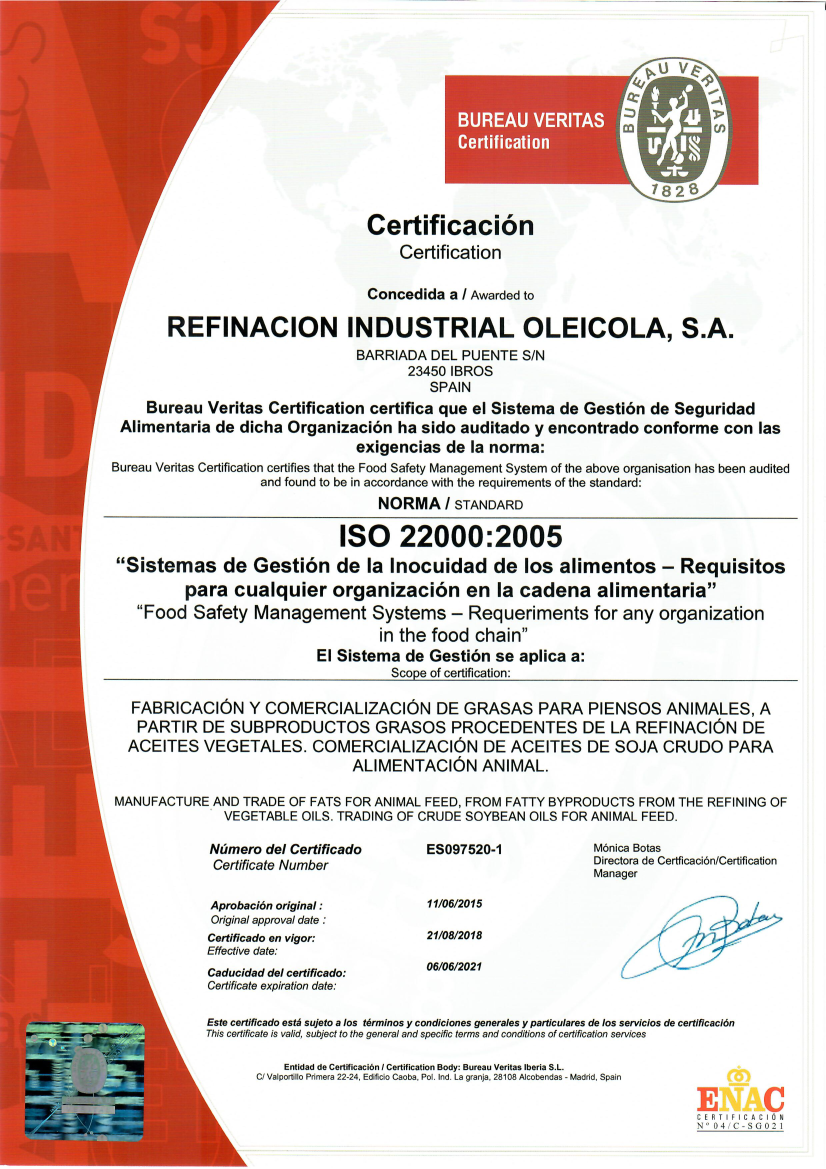
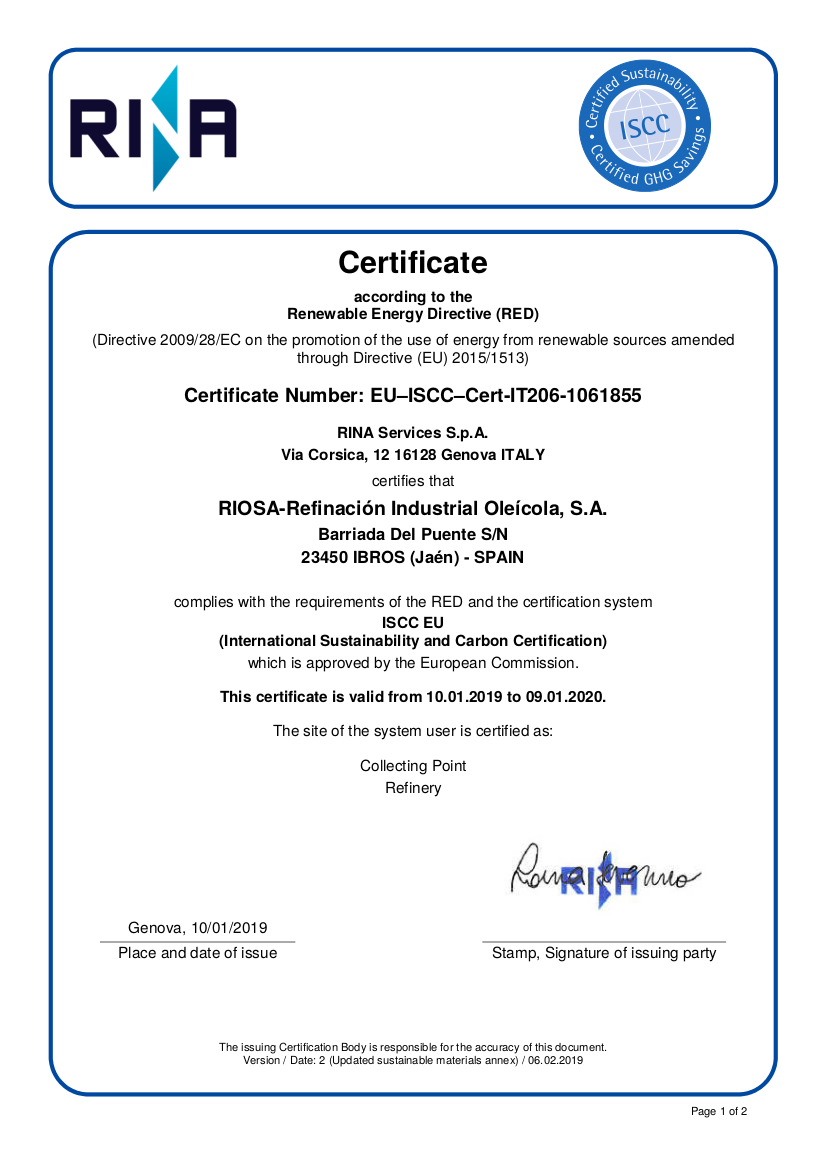
The certifications held by RIOSA, listed below, have been issued by accredited independent certification bodies—Bureau Veritas and RINA—following a comprehensive audit of the industrial plant in Ibros (Jaén) and all of our manufacturing, raw material sourcing, and marketing processes. Each certification is renewed annually through an external audit.
The certification ISO 14001:2015 This guarantees that RIOSA systematically identifies, measures, and improves the environmental impact of all its production processes. Unlike a statement of intent, ISO 14001 It requires an annually audited cycle: identification of environmental aspects (energy consumption, waste management, atmospheric emissions, spills and noise), setting measurable improvement objectives year after year, and independent verification by an accredited certifier —in our case, Bureau Veritas— that the objectives are met in operational reality, not just on paper.
In an oil and fat refinery, this translates into concrete commitments: productive circularity —we take advantage of by-products from the olive oil sector as raw materials and as a source of renewable energy, extending their useful life cycle instead of sending them to landfill—, progressive reduction of energy consumption per ton manufactured, exhaustive control of spills with periodic analysis, traceability of recoverable waste, and responsible purchasing policies from suppliers.
Adherence to ISO 14001 It forms an inseparable whole with our food certifications GMP+ and ISO 22000. For RIOSA, manufacturing with the highest quality and food safety and with the least possible environmental impact is a single, indivisible requirement, not two conflicting objectives.
The certification ISCC certifies that the raw materials we process and the products we market for biofuel applications meet the requirements of the European Renewable Energy Directive (RED II/III) on sustainability and reduction of greenhouse gas emissions.
A portion of the fats we produce is used to manufacture biodiesel. For this biodiesel to count as renewable energy in the European energy mix, it must be traceable back to a sustainable raw material—typically by-products and waste from the olive oil sector—with a verifiable reduction in GHG emissions compared to the reference fossil fuel. ISCC Our certifier audits every link in the chain: harvesting, storage, manufacturing, and transportation. FIGHT (Italy) annually verifies our mass balances, documentary traceability and emissions calculations.
For our customers in the energy sector, ISCC It is not a voluntary medal but a regulatory requirement: without certification ISCC Valid at every stage of the supply chain, the final biodiesel cannot be recognized as renewable in European national registries. Our commitment is to renew this certification annually without interruption, guaranteeing continuity of supply to a sector where any traceability failure propagates backward to all the suppliers that feed it.
- Type of certificate: ISO
- Ambit: production and marketing of oils and fats for animal feed
- Issued by the certifying company Bureau Veritas
- Certificate number ES158871 - 1
|
 |
- Type of certificate: ISCC
- Ambit: manufacturing, marketing and collection of raw materials
- Issued by the certifying company FIGHT
- Certificate number EU-ISCC-Cert-IT206-00003887

|
 |

Complementing the thermal use of biomass, in recent years we have invested in a self-consumption photovoltaic installation on the industrial roofs of the Ibros plant, partially financed with aid NextGenerationEU of the Recovery, Transformation and Resilience Plan. The facility is fully operational with 300 kW peak installed power and is in the process of being expanded to 500 kW peak by the end of 2026, in line with the increase in production capacity resulting from the commissioning of the expansion of our wastewater treatment plant.
The photovoltaic system easily covers the factory's average electricity consumption during daylight hours, and the surplus generated during off-peak periods is fed into the electricity grid under the surplus compensation scheme regulated by the Royal Decree 244/2019, contributing to the national renewable energy mix. The resulting net balance drastically reduces the carbon footprint associated with the electricity consumed by the plant.
Together with the thermal generation from the biomass boiler, photovoltaics complete an energy strategy in which most of the energy used in the production process comes from local renewable sources: Andalusian sunshine for electricity, and local olive oil and agroforestry byproducts for industrial heat. This is the natural consistency of a company whose business model is, by design, circular and local.

SUSTAINABILITY, TRACEABILITY AND ENVIRONMENTAL POLICY
RIOSA – REFINACIÓN INDUSTRIAL OLEÍCOLA, SA has been dedicated since 1965 to the production of exclusively vegetable fats, part of which are used for biodiesel production. These fats are produced from by-products, which is why at Riosa we utilize these by-products and extend their useful life.
For all these reasons, Management bases its commitment to sustainability and traceability on the following premises:
-
Commitment to reducing greenhouse gases.
-
Commitment to continuous improvement in all company processes.
-
Transparency and collaboration with subcontractors, suppliers, clients, and the community.
-
Analysis and management of the training, motivation, and preparation required by our staff to ensure the necessary skills for each position, with the best safety guarantee, in a timely manner.
-
Respect for the environment and prevention of pollution, personal injury, and health problems for all stakeholders.
-
Compliance with legal, environmental, health and safety requirements, those established by our clients, and those subscribed to by the organization itself.
-
Ensure the safety of all employees by actively working to prevent accidents, and convey our concerns to the companies that work on our behalf.
-
Prevention of harm and deterioration of the health of all stakeholders.
The quality policy of RIOSA - REFINACIÓN INDUSTRIAL OLEÍCOLA, SA is the means to guide the organization towards the improvement of its sustainability and traceability management system, which is why it remains displayed in a visible place for all staff and is communicated to the staff each time it undergoes a review so that it is implemented and maintained at all levels of the organization.
Ibros, January 8, 2020

Here we have compiled a summary list of the current environmental regulations and legislation applicable to our industrial plant, which we, of course, comply with scrupulously, and which we encourage all our clients to consult. Due to its production nature—industrial refining, its own wastewater treatment plant with administrative discharge authorization, a biomass steam boiler with atmospheric emissions, and continuous management of hazardous and non-hazardous waste generated by the process—RIOSA is subject to the framework of the Andalusian Unified Environmental Authorization (AAU), which integrates and supervises all environmental aspects in a unified manner. The following regulations, at the EU, national, and regional levels, outline the set of obligations that we verify annually through an external audit as part of our certification. ISO 14001.
European framework — Integrated pollution prevention and control
- Directive 2010/75/EU of the European Parliament and of the Council (FDI Directive): Directive on industrial emissions establishing the integrated pollution prevention and control regime, as well as the mandatory application of Best Available Techniques (BAT/BREF) in industrial installations.
- European Commission Implementing Decision (EU) 2018/1147: Decision establishing the conclusions on BAT for waste treatment, pursuant to Directive 2010/75/EU.
European framework — Waste
- Directive 2008/98/EC of the European Parliament and of the Council (Waste Framework Directive): Directive establishing the waste management hierarchy (prevention, reuse, recycling, recovery and disposal) and the principles of extended producer responsibility.
- European Commission Regulation (EU) 1357/2014: Regulation replacing Annex III to Directive 2008/98/EC on the characteristics that allow waste to be classified as hazardous.
- Regulation (EU) 2019/1021 of the European Parliament and of the Council: Regulation on persistent organic pollutants (POPs), with specific provisions for the management and disposal of waste containing such substances.
- Regulation (EC) 1013/2006 of the European Parliament and of the Council: Regulation concerning shipments of waste within and outside the European Union.
European framework — Water
- Directive 2000/60/EC of the European Parliament and of the Council (Water Framework Directive): It establishes the community framework for action in the field of water policy and the quality objectives for surface and groundwater bodies.
- Council Directive 91/271/EEC: Directive on the treatment of urban wastewater, applicable in its provisions to industrial discharges similar to urban discharges.
- Directive 2006/118/EC of the European Parliament and of the Council: Directive on the protection of groundwater against pollution and deterioration.
European framework — Atmosphere
- Directive 2008/50/EC of the European Parliament and of the Council: Directive on ambient air quality and cleaner atmosphere in Europe.
- Directive (EU) 2015/2193 of the European Parliament and of the Council (MCP Directive): Directive on the limitation of emissions into the atmosphere of certain pollutants from medium combustion plants, applicable to industrial biomass steam boilers.
European framework — Chemical substances
- Regulation (EC) 1907/2006 of the European Parliament and of the Council (REACH): Regulation concerning the registration, evaluation, authorization and restriction of chemical substances and mixtures.
- Regulation (EC) 1272/2008 of the European Parliament and of the Council (CLP): Regulation on classification, labelling and packaging of substances and mixtures, also applicable to the identification of hazardous waste.
European framework — Climate change and renewable energies
- Directive (EU) 2018/2001 of the European Parliament and of the Council (RED II): Directive on the promotion of the use of energy from renewable sources, regulatory framework under which our ISCC certification for the supply of raw materials to the manufacture of biodiesel is based.
- Regulation (EU) 517/2014 of the European Parliament and of the Council: Regulation on fluorinated greenhouse gases, applicable to industrial refrigeration and air conditioning equipment.
State regulations — Integrated prevention and environmental assessment
- Royal Legislative Decree 1/2016 of the Government of Spain: Royal Legislative Decree approving the consolidated text of the Law on Integrated Pollution Prevention and Control, consolidated national transposition of the IED Directive.
- Royal Decree 815/2013 of the Government of Spain: Royal Decree approving the Industrial Emissions Regulation and developing Law 16/2002 on Integrated Pollution Prevention and Control.
- Law 21/2013 of the Government of Spain: Environmental Assessment Law, applicable to substantial modifications of industrial facilities and environmental authorization procedures.
State regulations — Waste
- Law 7/2022 of the Government of Spain: Law on waste and contaminated soils for a circular economy, updated framework for waste management in Spain and transposition of Directive 2018/851/EU.
- Royal Decree 553/2020 of the Government of Spain: Royal Decree regulating the transfer of waste within the territory of the State.
- Royal Decree 833/1988 of the Government of Spain: Royal Decree approving the Regulation for the implementation of the Basic Law on Toxic and Hazardous Waste, supplemented by Royal Decree 952/1997 of modifications.
- Royal Decree 1481/2001 of the Government of Spain: Royal Decree regulating the disposal of waste by landfill.
State regulations — Water
- Royal Legislative Decree 1/2001 of the Government of Spain: Royal Legislative Decree approving the consolidated text of the Water Law, basic framework of the public hydraulic domain.
- Royal Decree 849/1986 of the Government of Spain: Royal Decree approving the Regulation of the Public Water Domain, which regulates the system of discharge authorizations and the limits of emission to public watercourses.
- Royal Decree 817/2015 of the Government of Spain: Royal Decree establishing the criteria for monitoring and evaluating the status of surface waters and the environmental quality standards.
State regulations — Atmosphere
- Law 34/2007 of the Government of Spain: Air quality and atmospheric protection law, basic national framework for the control of emissions into the atmosphere.
- Royal Decree 100/2011 of the Government of Spain: Royal Decree updating the catalogue of potentially polluting activities of the atmosphere (CAPCA) and establishing the basic provisions for its application, applicable to our biomass steam boiler.
- Royal Decree 1042/2017 of the Government of Spain: Royal Decree on the limitation of emissions into the atmosphere of certain pollutants from medium combustion plants, national transposition of the MCP Directive.
- Royal Decree 102/2011 of the Government of Spain: Royal Decree relating to the improvement of air quality.
State regulations — Contaminated soils
- Royal Decree 9/2005 of the Government of Spain: Royal Decree establishing the list of potentially soil-polluting activities and the criteria and standards for declaring contaminated soils.
State regulations — Self-consumption of electricity (photovoltaic installation)
- Royal Decree 244/2019 of the Government of Spain: Royal Decree regulating the administrative, technical and economic conditions of self-consumption of electrical energy, applicable to our self-consumption photovoltaic installation.
Andalusian regional regulations
- Law 7/2007 of the Andalusian Regional Government (GICA): Andalusia's Integrated Environmental Quality Management Law, the regional framework that regulates the Unified Environmental Authorization (AAU) under which our industrial plant in Ibros operates.
- Decree 356/2010 of the Regional Government of Andalusia: Decree regulating the unified environmental authorization and establishing the organization and operation regime of the register of authorizations for actions subject to environmental prevention and control instruments.
- Decree-Law 5/2014 of the Regional Government of Andalusia: Decree-law regulating normative measures for economic activity and environmental protection, with modifications to the GICA.
- Decree 73/2012 of the Regional Government of Andalusia: Decree approving the Waste Regulations of Andalusia, which details the management, transfer and registration of hazardous and non-hazardous waste in the autonomous region.
- Decree 109/2015 of the Regional Government of Andalusia: Decree approving the Regulation of discharges into the public water domain and the public maritime-terrestrial domain of Andalusia, applicable to the administrative discharge authorization of our wastewater treatment plant.
- Law 9/2010 of the Andalusian Regional Government: Water Law for Andalusia, an autonomous complement to the state framework of the Water Law.

 (+34) 953692000
 riosa@riosa.com
 Whatsapp Messg
 Telegram Message